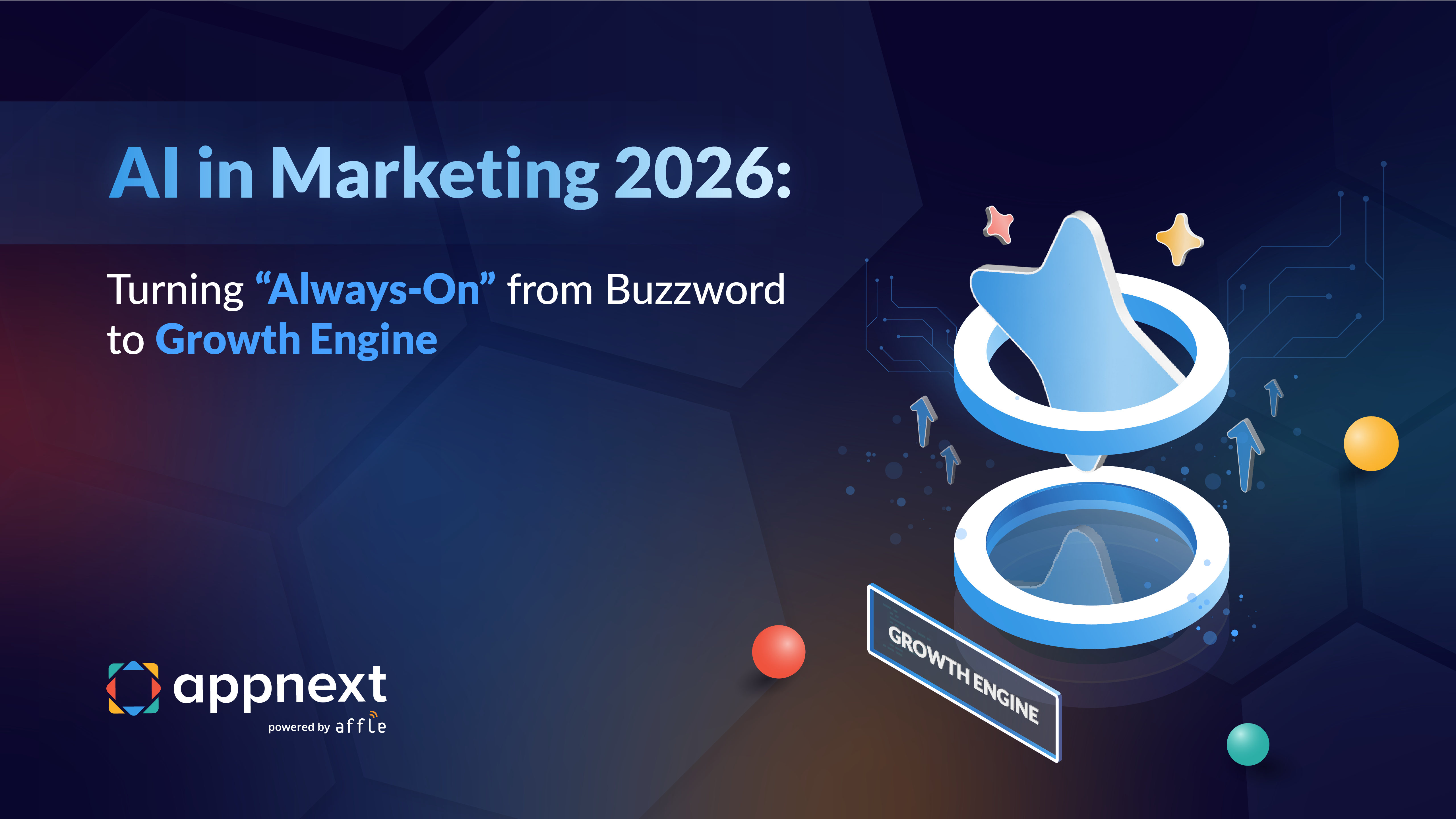
As we move into 2026, AI in marketing is undergoing a structural shift. The industry is moving away from short-lived campaigns, manual optimization, and channel-heavy execution toward something far more foundational: Always-On, intent-led app discovery powered by OEM ads and on-device intelligence.
The new growth equation is simple but profound: Visibility without relevance is noise. Discovery with intent is momentum.
The 2026 Shift: From Campaign Marketing to Continuous Discovery
The holiday season drives a surge of installs fueled by gifting, discounts, and seasonal behavior. But once Q1 begins, user behavior normalizes. People settle back into routines, work, commuting, planning, self-improvement, and everyday problem-solving.
This behavioral reset exposes a critical truth about modern growth:
Users don’t stop discovering apps. They stop searching for them.
In 2026, discovery increasingly happens without an explicit search query. It happens when context, timing, and need intersect often within the device itself. This is where AI in marketing evolves from a performance tool into a continuous discovery engine.
Why Intent Is the Core Signal in AI Marketing
Traditional marketing models rely heavily on historical actions clicks, installs, past categories. But intent is not static. It shifts with time of day, location, mindset, and routine.
Modern AI systems decode intent through on-device user intentions, such as:
- Daily usage Behavior
- Time-based behavior shifts
- Content consumption interactions
- Environmental context
Instead of asking “What did this user do before?”, AI now answers:
“What is this user most likely to need next?”
This shift is foundational to app discovery in 2026, where relevance is determined in real time, not assumed from the past.
What “Always-On” AI in Marketing Really Means
In 2026, “Always-On” does not mean running ads endlessly. It means Always-On intelligence.
The Core Pillars of Always-On AI Marketing
Predictive Context Mapping
AI continuously interprets user behavior to anticipate emerging needs across daily routines.
Real-Time Intent Alignment
Apps surface when intent forms, not when a campaign window opens.
Native On-Device Presence
Discovery happens within system-level environments, not external media feeds.
Static segmentation is no longer viable. A user’s intent can change multiple times a day and AI adapts instantly.
How OEM Ads Enable On-Device App Discovery
This evolution in AI-driven discovery is made possible by OEM advertising ecosystems.
OEM ads operate at the device level, giving marketers access to native touchpoints where intent is naturally expressed, such as:
- Lock screens
- System search and recommendation layers
- Content and app suggestion hubs
- Pre-installed discovery environments
Unlike traditional advertising, OEM marketing embeds app discovery directly into the operating system experience.
A Practical Example of OEM-Led App Discovery
A user installs a travel app during the holiday season.
In January:
- They are no longer planning long vacations
- They are commuting daily
- Checking calendars
- Thinking about short breaks or weekend plans
An AI-powered OEM discovery platform can intelligently surface:
- Local commute utilities
- Weekend trip planners
- Nearby experience features
These suggestions appear within native device environments such as system search or contextual recommendation spaces without requiring the user to actively search. This is search-optional discovery: Apps appear when relevance exists, not when attention is demanded.
Why OEM Marketing Is Central to AI in Marketing 2026
OEM marketing transforms AI from a media optimization layer into a growth infrastructure.
What Makes OEM Ads Critical
- On-device by design: Integrated into everyday digital behavior
- Context-aware: Driven by real-time user intentions, not assumptions
- Non-intrusive: Discovery feels assistive, not disruptive
- Always-On: Independent of campaign schedules
As emphasized by Appnext, modern app discovery is rooted in predictive relevance, where apps surface when intent is already forming, making discovery feel natural rather than forced. This approach is increasingly essential in a privacy-first, signal-constrained ecosystem.
Conclusion: AI in Marketing Is Becoming Infrastructure
In 2026, AI in marketing is no longer an add-on, it is infrastructure. Growth is no longer driven by reach alone, but by precision, timing, and contextual relevance.
By combining:
- Always-On AI systems
- OEM advertising ecosystems
- On-device app discovery
Marketers can align apps with real user needs, moment by moment, context by context. The brands that win will not be the loudest. They will be the ones that appear exactly when intent emerges.
FAQs
What is intent-led app discovery in AI marketing?
Intent-led app discovery uses AI to analyze on-device signals, such as time, behavior, and context to surface apps when users are most likely to find them useful. Discovery happens proactively through OEM environments, without requiring a manual search.
How do OEM ads support AI-driven marketing strategies?
OEM ads provide access to native device surfaces. When combined with AI, they enable apps to appear at moments of real intent, aligning visibility with user needs rather than campaign timing.
Why is Always-On AI important for app discovery in 2026?
User intent is dynamic. Always-On AI continuously adapts to changing behavior, ensuring app discovery remains relevant across daily routines without relying on static targeting or fixed campaigns.

Comments are closed.