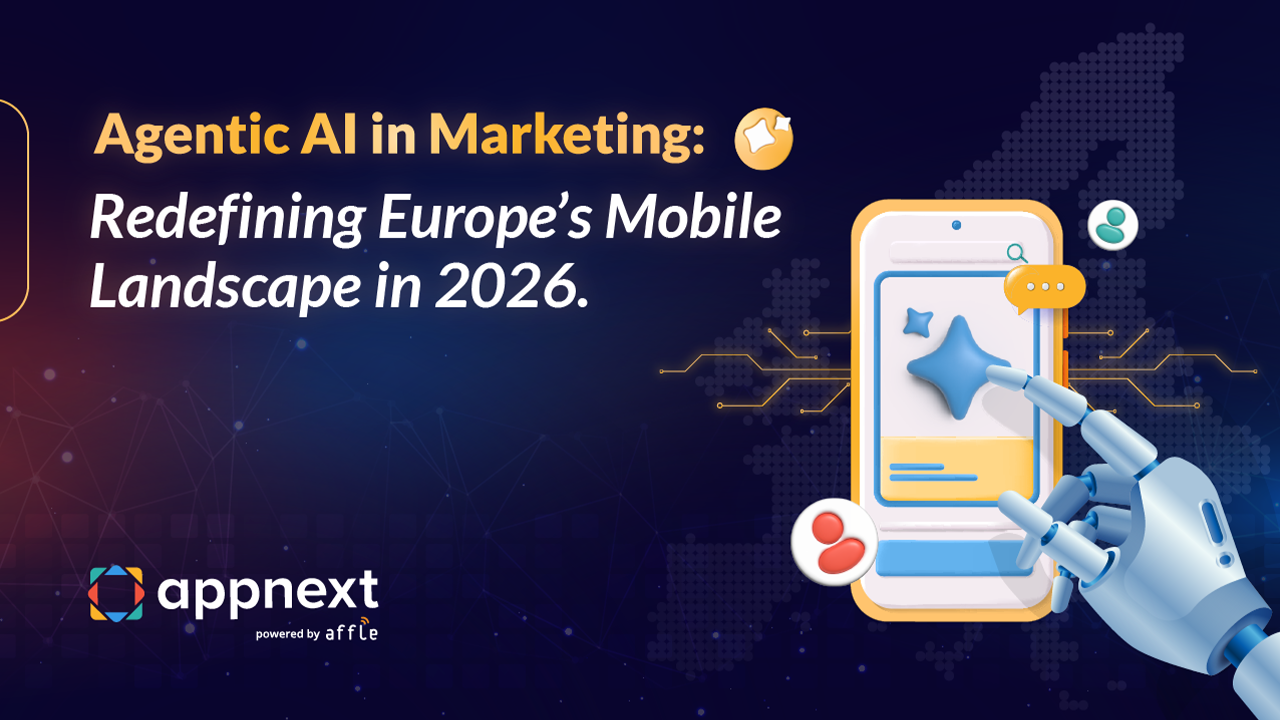
- From Chat to Action: Agentic AI is moving beyond generating text to executing complex, autonomous goals, fundamentally changing how users interact with their devices.
- The End of “Interruption”: By 2026, mobile advertising in Europe will shift from interruptive ads to assistive experiences that solve user problems in real-time.
- Context is King: Success will rely on predictive technology like Appnext Timeline, which anticipates user needs before they even search.
The Next Leap: Beyond Generative AI
If 2024 was the year we figured out how to talk to AI, 2026 will be the year AI starts doing the work for us. While Generative AI amazed us by creating content, Agentic AI in marketing is emerging as the true disruptor. Unlike its predecessor, which waits for a prompt, Agentic AI perceives, reasons, and acts autonomously to achieve specific goals.
For app marketers across Europe, this signals a massive shift. We are moving away from static campaigns towards dynamic, autonomous systems that understand user intent deeply. In a region characterized by diverse languages, strict privacy regulations (GDPR), and high digital maturity, the efficiency and precision of Agentic AI are not just “nice to have”, they are becoming the baseline for survival.
By 2026, the mobile ecosystem is likely to evolve from a collection of apps into a network of intelligent agents working on the user’s behalf. The question is: is your marketing strategy ready to speak their language?
The 2026 Mobile Advertising Landscape
The era of “spray and pray” user acquisition is officially over. In the agentic future, mobile advertising moves from static ads to intelligent, intent-aware butlers.
In this new landscape, users won’t necessarily go to an app store to find a solution. Instead, their on-device AI agent will identify a need, perhaps booking a flight for an upcoming meeting found in their calendar and surface the right travel app at that exact moment.
How European Markets Will Adapt:
- Hyper-Efficiency: With rising media costs, European marketers will leverage Agentic AI to automate budget allocation in real-time, moving spend not just by channel, but by specific user intent signals.
- Privacy-First Personalization: Agentic systems operate on-device, processing data locally. This aligns perfectly with Europe’s privacy-first mindset, allowing for deep personalization without data ever leaving the user’s handset.
- The “Invisible” Funnel: The marketing funnel will become invisible. Discovery, consideration, and conversion will happen in a single, fluid motion initiated by the device’s understanding of the user.
Understanding the Shift
Q: How does Agentic AI differ from current marketing automation tools?
Autonomy: Traditional automation follows a strict “if this, then that” script. Agentic AI figures out the “how” on its own to reach a goal.
Adaptability: It learns from real-time environment changes (e.g., a sudden drop in user retention) and adjusts strategies without waiting for human input.
Multi-Step Reasoning: It can chain complex tasks together, such as analyzing a user’s calendar, checking weather data, and recommending a ride-hailing app, all in one flow.
Appnext Timeline: The Engine of Intent-Based Discovery
To leverage Agentic AI in marketing, you need technology that understands the “when” and “why” of user behavior. This is where Appnext is already ahead of the curve.
Appnext’s patented Appnext Timeline technology functions as the foundational layer for this agentic future. It doesn’t just look at what a user downloaded last month; it analyzes real-time context to predict what the user is about to do next.
- Predictive, Not Reactive: Just as an autonomous agent perceives its environment, Appnext Timeline analyzes location, device status, and usage patterns to understand intent.
- Contextual Integration: It enables app marketing to bypass the noise. If a user in London connects their headphones at 8:00 AM, Appnext understands the context, “morning commute” and surfaces a music or podcast app recommendation natively.
- Closing the Gap: As Appnext thought leadership puts it, “Relevance isn’t random it’s predictive: when you understand what the user will do next, discovery becomes inevitable.”
In the 2026 landscape, Appnext acts as the bridge between the user’s latent intent and the marketer’s app, effectively serving as the “agent” that facilitates the introduction.
Strategic Moves for European Marketers
To thrive in this agentic era, marketers need to rethink their KPIs. It is no longer about impressions; it is about “fulfillment.” Did your app appear when the user (or their agent) had a specific problem to solve?
- Optimize for Intent, Not Keywords: Shift your mobile marketing strategies to focus on use cases. Your app needs to be the clear “answer” to a specific “question” the AI identifies.
- Embrace OEM Partnerships: Since Agentic AI will likely live at the OS level (on the device itself), partnering with platforms like Appnext that are integrated into the hardware of manufacturers (Xiaomi, Oppo, Vivo, Honor) is crucial. This gets you “upstream” access to the user.
- Trust as a Currency: In Europe, users will only delegate tasks to agents they trust. Ensure your app experience is frictionless and secure, as agentic systems will deprioritize apps with high churn or poor UX.
Conclusion
The rise of Agentic AI represents the most significant shift in mobile advertising since the invention of the app store. By 2026, the winners won’t be the apps with the loudest ads, but the ones that are most seamlessly integrated into the user’s daily flow. With technologies like Appnext Timeline, marketers have the tools today to start building for this predictive, autonomous future. The goal is no longer just to be seen—it is to be the solution found at the exact moment of need.
FAQs regarding Agentic AI in Mobile Marketing
1. What exactly is Agentic AI in marketing?
Agentic AI refers to artificial intelligence systems that can function autonomously to achieve marketing goals. Unlike generative AI, which creates content, Agentic AI:
- Perceives its environment and user data.
- Reasons through complex problems to determine the best course of action.
- Executes tasks (like optimizing ad spend or surfacing an app) without constant human oversight.
- Adapts to changing market conditions in real-time.
2. How will mobile marketing change in Europe by 2026?
The landscape will shift from interruptive display ads to assistive, intent-based recommendations. Key changes include:
- Reduced Friction: Apps will be suggested by on-device agents before users search.
- Privacy-Centric Discovery: Marketing will rely less on cloud-based tracking and more on on-device, edge-computing signals.
- Solution-Oriented: Campaigns will focus on fulfilling immediate user intents (e.g., “I need a ride”) rather than broad brand awareness.
3. How does Appnext fit into the Agentic AI trend?
Appnext is a pioneer in the predictive technology required for agentic workflows.
- Predictive Discovery: It anticipates the user’s next move, surfacing apps at the moment of intent.
- OEM Integration: By sitting on the device, Appnext enables the seamless, native experiences that Agentic AI relies on.
4. Is Agentic AI compatible with GDPR and European privacy laws?
Yes, Agentic AI often enhances privacy compliance.
- On-Device Processing: Many agentic systems process data locally on the smartphone (Edge AI) rather than sending it to the cloud.
- Data Minimization: Agents only access the specific data needed to complete a task.
- User Control: European regulations ensure users have transparency and control over how autonomous agents utilize their data.
5. What skills do app marketers need for the Agentic AI era?
Marketers must evolve from campaign managers to ecosystem architects. Essential skills include:
- Data Strategy: Understanding how to structure app data so AI agents can “read” and recommend your service.
- Contextual Marketing: Learning to map user journeys based on real-time triggers rather than static demographics.
- Technical SEO/AEO: Optimizing app content to be the top “answer” for AI-driven queries.


Comments are closed.