- A Year Like No Other: 2026 is packed with major global events, from the FIFA World Cup to the Winter Olympics, creating unprecedented opportunities for app growth.
- The Second Screen Reality: Fans are no longer just watching; they are engaging on mobile, ordering food, and shopping for merchandise simultaneously.
- Context is King: Winning these high-intent moments requires AI-powered recommendations and deep personalization, not generic broad targeting.
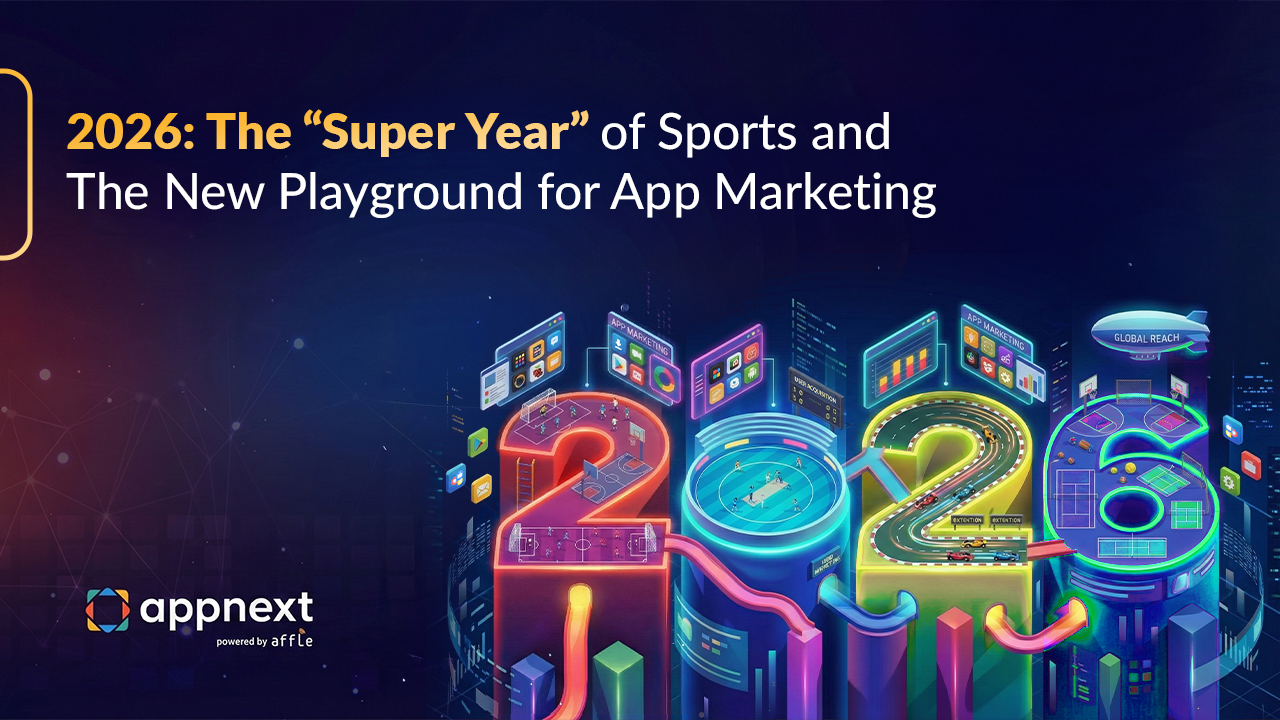
2026 is shaping up to be a “Super Year” for the sporting world, and it’s set to rewrite the record books.
It’s a rare alignment of the stars, with the FIFA World Cup, the Winter Olympics, the Commonwealth Games, and the ICC Men’s T20 World Cup all taking place within the same twelve-month span.
For the average fan, this is paradise. For the app marketer, it’s the ultimate test of agility and strategy.
During these events, fans are glued to their screens, often more than one. The modern sports viewer is a true multi-screen native. They may be watching a match on a smartphone, connected TV, or even inside a stadium, while simultaneously scrolling on their phone to check stats, debate on social media, order a celebratory meal, or buy their favorite team’s jersey.
This behavior creates a massive surge in mobile intent. To capitalize on it, your app marketing strategy must go beyond simple visibility and focus on capturing engagement at the exact moment excitement peaks.
Why This Is a Multi-Screen Opportunity
The biggest mistake marketers make during sporting festivals is assuming that only sports streaming apps benefit. The reality is that major sporting events create a halo effect across the entire app ecosystem.
When a match is on, the “second screen” (the mobile device) becomes the remote control for the fan’s life.
- Food & Delivery: The halftime or an innings break surge is real. Fans order food and beverages to complement the viewing experience.
- E-Commerce: Seeing a star player score often triggers an impulse buy for jerseys or branded merchandise.
- Travel & Utility: With events like the FIFA World Cup and Winter Olympics drawing global crowds, travel bookings, local transport, and translation apps see massive spikes in user acquisition.
The challenge isn’t finding the users; they are there. The challenge is cutting through the noise. This is where AI-powered recommendations in real time play a pivotal role. Instead of bombarding users with generic ads, AI allows you to understand the context, is the user checking scores? Are they in a “celebratory” mood?, and serve a recommendation that feels like a natural extension of their experience.
How does “second-screening” actually impact app conversion rates during live sports?
- High Intent Intervals: Conversions for food and retail apps spike during breaks (halftime, timeouts, replays) rather than during gameplay, meaning timing is critical.
- Social Validation: Users often jump to social apps to discuss plays, making social-adjacent placements highly effective for discovery.
- Short Attention Windows: Because the user’s primary focus is the game, ad interactions must be frictionless; deep links and instant app experiences perform better than complex funnels.
What Are the Most Important Dates in the 2026 Sports Calendar?
To win in 2026, you cannot be reactive. You need to map your user acquisition campaigns against this global sporting calendar. Here is the roadmap of high-intent moments where you should be doubling down:
Q1: The Global Kick-Off
- SA20 (South Africa T20 League): Dec 2025 – January 2026. A prime window for targeting the African market.
- Winter Olympics (Milano Cortina): Feb 6, 2026 – Feb 22, 2026. Expect high engagement in Europe and North America, particularly for news and travel apps.
- ICC Men’s T20 World Cup (India & Sri Lanka): Feb 7, 2026 – Mar 8, 2026. A colossal event for the sub-continent. If your app serves India or South Asia, this is your Super Bowl.
Q2: The Cricket & Football Frenzy
- Indian Premier League (IPL): Mar 2026 – May 2026. The annual behemoth of cricket marketing. High volume, high competition.
- FIFA World Cup (Global): 11 Jun 2026 – 19 Jul 2026. The undisputed king of sporting events. This will drive traffic globally, with massive spikes in Brazil, Europe, and LATAM.
Q3: The Summer of Multi-Sport
- Commonwealth Games (Glasgow): Jul 23, 2026 – Aug 2, 2026. Key for UK and Commonwealth markets.
- Rugby Mid-Year Tests & Championship: July 2026 – Nov 2026. A steady engagement driver for the UK, Australia, New Zealand, and South Africa.
- Men’s Hockey World Cup: Aug 2026 (mid-late). Big for European and Indian audiences.
Q4: The Sprint to the Finish
- Asian Games: Sept 19, 2026 – Oct 4, 2026 . A massive opportunity for APAC-focused apps.
- Formula 1 (São Paulo GP): Nov 6 – 8. High-value demographic targeting for luxury and lifestyle apps.
Where Does Context Matter Most, and How Does Personalization Win?
With millions of dollars pouring into ad spend during these periods, generic creatives will get lost. Personalization is your differentiator. (Add appnext timeline)
A “one-size-fits-all” approach to app marketing during the FIFA World Cup, for example, is a wasted opportunity. A user in Brazil watching the game has different needs than a user in Japan.
- Contextual Relevance: If you are a food delivery app, don’t just say “Order Now.” Say “Match starting soon? Get your pizza before kickoff.”
- Geo-Specifics: Use the location of the event to tailor travel deals. If the T20 World Cup is in Sri Lanka, travel apps should be pushing flights and hotels to Colombo for users in neighboring regions.
- Interest-Based Targeting: Use on-device intelligence to distinguish between a casual viewer and a die-hard fan. The former might want highlights; the latter might want deep statistical analysis apps or fantasy sports platforms.
Conclusion
2026 offers a unique runway for app growth, but the window of opportunity for each event is tight. The winners will not be the marketers with the biggest budgets, but those with the smartest timing. By leveraging the multi-screen behavior of fans, utilizing AI-powered recommendations to intercept intent, and prioritizing personalization, you can turn these global festivals into long-term user retention victories.
The fans are ready. The calendar is set. Is your app ready to take the field?
FAQs
How early should I start my user acquisition campaigns for major sporting events?
- Ramp up early: innovative marketers start “warm-up” campaigns 2-3 weeks before the opening ceremony to build brand recall.
- Pre-install strategy: Aim to get your app on the user’s device before the first whistle blows so you are the go-to option when the need arises.
- Cost efficiency: CPIs often skyrocket during the event; acquiring users beforehand is usually more cost-effective.
Which app categories benefit most from sporting events besides streaming apps?
- Food & Beverage: Delivery apps see massive spikes during matches as fans host watch parties.
- E-commerce & Retail: Sales of team jerseys, electronics (TVs), and memorabilia surge.
- Travel & Mobility: Ride-sharing and hotel booking apps see high demand, especially in host cities and countries.
- News & Social: Fans constantly check scores and share opinions, driving engagement for content platforms.
How can AI-powered recommendations help during live games?
- Real-time Context: AI can analyze user behavior to trigger recommendations at high-intent moments (e.g., during halftime).
- Reduced Friction: By suggesting the right app exactly when the user looks at their phone, AI removes the need for search, increasing conversion rates.
- Predictive Analysis: AI can identify users likely to be interested in specific sports based on past behavior, ensuring your ad spend is focused on relevant audiences.
What is the best way to retain users acquired during these “hype” periods?
- Immediate Value: Ensure the onboarding process is seamless so they get value instantly during the game.
- Post-Event Content: Pivot your messaging after the tournament ends (e.g., “The World Cup is over, but the hunger isn’t—here’s a discount”).
- Gamification: Use prediction games or loyalty points related to the tournament to keep them coming back daily.
How important is localization for global events like the FIFA World Cup?
- Cultural Nuance: It is absolutely critical; a campaign that works in the UK for the World Cup might fall flat in Brazil due to different fan cultures.
- Language: Ensure not just the language, but the sports terminology used in your creative is locally accurate (e.g., Football vs. Soccer).
- Time Zones: Schedule push notifications and campaigns based on local match times, not just the host country’s time zone.

Comments are closed.